
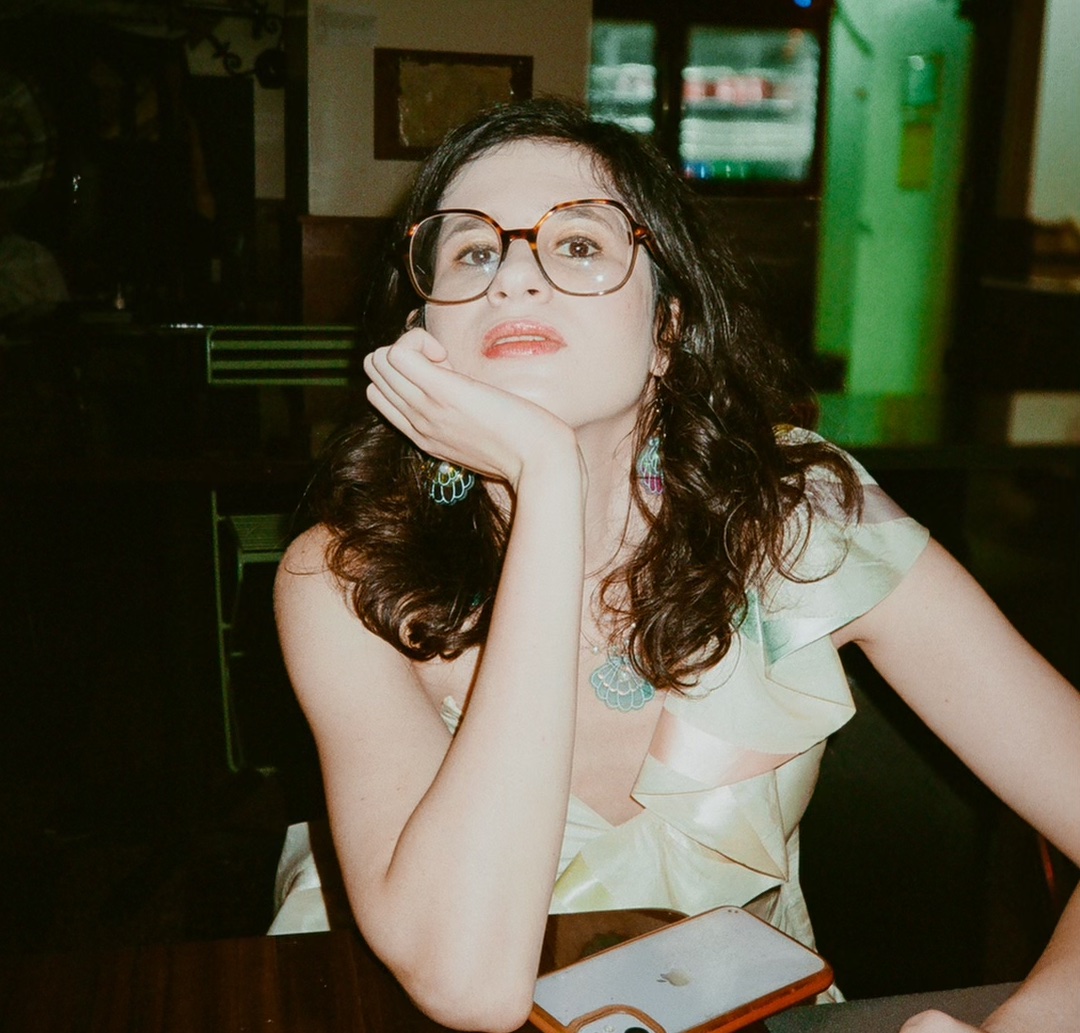
When I log onto a 7 P.M. zoom call with New York-based singer-songwriter Rebecca Karpen, we start chatting about the normal pleasantries; work, life in your twenties, the best (and worst) after-hour haunts in the city and Brooklyn, and of course, her beloved Sufjan Stevens.
The Sufjan Stevens influence is palpable on Karpen’s emotionally-wrought new song “23,” especially with the way she utilizes negative space in the recording – leaving in pauses, gaps, and high-frequency white noise in order to heighten the urgency of the emotional state she was in at the time of writing it, which was a state of desperation and loneliness.
Writing can often provide a sense of closure from messy situations when it isn’t provided by those involved, whether it be through unsent letters, journaling, and in many cases, songwriting. In “23,” Karpen takes responsibility for her own errors in judgment while acknowledging that the authority figure she’s writing about who took advantage of her should have known better and acted differently (“I know my record isn’t clean / Painted them a you I wanted you to be / But fantasies are commonplace for girls of nineteen”).
A Grrrl’s Two Sound Cents caught up with Rebecca Karpen to discuss the process of writing “23,” and how songwriting as a practice allows her to take control of her narrative.
How are you doing?
I’m doing good, I’m a bit nervous. You’re in New York too, right?
Yes, and you?
Yeah, I’m in the village. What about you?
I’m in Chelsea!
Oh nice, I went to middle school around there.
So to get into it, how long have you been playing music and what gave you the push to start releasing it?
I come from a very musical family. My father grew up playing the french horn semi-professionally, so he was really determined to give my sister and I a very music-heavy upbringing. So I started taking piano lessons around when I was in kindergarten. I never practiced, so I remember like next to nothing. But I also took vocal lessons, and that was my one thing I could do well.
I was a very awkward kid, so singing well was the one way I could get the positive attention that I craved. I started writing songs and taking it more seriously in high school, so I started teaching myself ukulele. I was terrible at it, but I practiced relentlessly and then expanded to a baritone ukulele, which is basically the top four strings of a guitar. I eventually graduated to guitar on the basis of being shamed out of the easier instruments, but it really helped me to grow in terms of forcing myself to learn multiple instruments. It also helped me make a wider breadth of music.
I’m almost done working on an album and I was working with Jake Tavill at Indigo Soul NYC. I’m still making all the decisions. I call the shots and it’s his job to make them happen, but it’s really cool to also have somebody to bounce ideas off of who also knows what they’re doing. I can “produce” in the sense that I can record sound and put it on the internet, but is that idea? Not in the way I do it. So I like to learn along with people, but I’m more of a singer-songwriter who doesn’t trust herself with tech.
What is one surprising skill you’ve picked up through self-teaching yourself a few of these techniques?
Singing quickly. Being able to squeeze a large volume of words into a much smaller volume of breath. The more work I did, the much easier breath control became through repetition. Mostly I would start by rushing, but then it became this cadence that I got into a routine of practicing.
I think a lot of it comes down to allowing myself to take that space to deal with my emotions. It gives me a lot of peace mentally to write out all my angry, bizarre, frustrated feelings onto a blank page and do nothing with it.
– Rebecca Karpen

When you first started out, what artists had the biggest imprint on you?
I feel like this is a pretty typical answer, but I have to say Taylor Swift, mostly because of [the agency she had at] her age. I feel like a lot of teen idol stars would often have music written and engineered for them by older Swedish men who were writing from the perspective of what they thought a teenage girl sounded like. With Britney Spears [and Max Martin] and even early Avril Lavigne stuff that she wrote with The Matrix, you get a very skewed perception of youth and what it means to be a woman.
There was also a real sense of shame in being young. So many of the songs I heard as a kid were sung by young women wishing they were older, or they were singing about very mature emotions that I just couldn’t relate to. What was so interesting about early Taylor Swift was that you could tell she wrote her own material because it sounded like a sixteen-year-old girl. And she wasn’t ashamed of her youth. She celebrated it. What was so refreshing about her success is that it proved people were willing to listen to the concerns and anxieties of younger people. More importantly, it taught me that as a songwriter, I could write authentically about my life without putting on a mask of maturity that I didn’t have.
I also grew up in a really weird musical household. My dad only listened to stuff like classical music stations like WQXR, and The Beatles. Then there’s my mom, who only listened to folk music like Peter, Paul and Mary and Gordon Lightfoot. I didn’t grow up with Joni Mitchell or Bob Dylan, I didn’t discover them until much later in high school. I also didn’t listen to a lot of classic rock because my family only listened to stuff like Shostakovich and ‘60s protest music.
I would say another one of my biggest influences is Jill Sobule. She’s probably best known for doing the song “Supermodel” in Clueless during the makeover scene. But she was so good at marrying the humorous and the sincere, because that’s what life is. It’s chaotic, it’s crazy, it’s funny, and it’s upsetting. Years later I took a songwriting course from her during the pandemic. Nobody writes like her, and she’s a massive inspiration to me.
That’s incredible. I know getting to be in proximity to your idols can often be both exciting and jarring. What was your biggest takeaway from that experience?
Honestly, my biggest takeaway is that they’re only people. A lot of fear can be built into our perception of these people as idols, but my biggest takeaway with Jill was that she’s just a nice lady who writes incredible work and one of those songs ended up on a movie soundtrack. It honestly showed me that most people are going to be supportive of your work, if given the opportunity to hear it. It gave me a renewed sense of pride and confidence in the work that I do.
You mentioned earlier that singing was a great way to take ownership of your voice. So when you run into situations where you feel like you aren’t being heard, how does singing allow you to reclaim that?
I think a lot of it comes down to allowing myself to take that space to deal with my emotions. It gives me a lot of peace mentally to write out all my angry, bizarre, frustrated feelings onto a blank page and do nothing with it. Taking that energy and turning it into something creative is really helpful in the world we live in where you can’t yell at a shitty boss and we’re unfortunately somewhat limited in our personal relationships in terms of who we can actually go after, especially when there’s power dynamics involved in terms of people I’ve worked with and people I’ve studied under, even people I’ve collaborated with. I can’t necessarily sully those connections or relationships by punching them in the face or giving them a violent tongue-lashing, because there will be consequences.
I wrote the majority of it at 3 AM in my apartment curled up into a ball. And I wanted the recording to also reflect that. I wanted it to sound bare-bones and minimal, and I wanted people to be able to hear the squeaking of my fingers on the guitar, my breath, and the cracks in my voice.
– Rebecca Karpen

I love how the performed emotions and imperfections – scattered breath, hiccups, and sighs – were kept on the record for you’re latest song “23.” I’m curious about your thoughts on the field of sound and how that can be an effective signifier of emotion on a record?
A musician who I really enjoy in terms of emotion and performance is Sufjan Stevens. He wrote the album Carrie and Lowell about the death of his mother, and I thought that was an incredible use of minimalism and negative space. He recorded a majority of the album on a shitty iPhone in hotel rooms, and in a lot of them you can hear his breathing and the sound of air conditioners in the background. People who know me know that I wear my heart on my sleeve. So I believe the more negative space there is, the more human it becomes. I love pop music, but I believe the way we use sound and space has a lot to do with what we want to communicate. And what I wanted to communicate with this song was isolation. I wrote the majority of it at 3 AM in my apartment curled up into a ball. And I wanted the recording to also reflect that. I wanted it to sound bare-bones and minimal, and I wanted people to be able to hear the squeaking of my fingers on the guitar, my breath, and the cracks in my voice. In my opinion, it’s a naked song, and having that amount of empty space pays tribute to how isolating the experience was, but also allows me the space that I need to reinforce the strength that even a song all about emptiness and loneliness can still fill a room.
I’m also a big fan of artists who forge their own path when it comes to sound without following the rules. One of my favorite artists of all time is Liz Phair, and she couldn’t play guitar very well or understand how chords worked, but she made that work for her and went “Okay, I’m sad, so I’m going to make a whole double album about being sad while playing chords that don’t exist.” And she just recently made Rolling Stone’s Top Guitarist’s of All Time list, so shoutout to the queen.
What are your top-streamed songs of this week?
Right now I’m obsessed with Amalia Juliane’s album This Is Not My Mind. It’s very freak-folk coded, and it’s basically her experiencing an emotional breakdown over the chromatic scale. I grew up loving The Moldy Peaches and even Adam and Kimya’s solo stuff, so I really adore that sound. I really love the song “Sofia I’m Sorry” by Jesse Detor. “Angst in my Pants” by Sparks is another one. I’ve also been listening to a lot of Laufey and Joy Crookes, and of course The Tortured Poets Department. Is it cringe? Yes. But I really appreciate her being too honest and unhinged.
I’ve also been super into a lot of the stuff my friends are putting out. Brea Fournier & the Dream Ballet just put out a fantastic album called Manic Pixie Dream Girl! where she sings about wishing Gwyneth Paltrow stayed a headless corpse because of intermittent fasting. My friend Emily Sara is working on an album based on the story of Ariadne and Theseus. Lady Lychee is another great one. It’s a really awesome and lovely sisterhood in the musical community I’ve found here.
KEEP UP TO DATE WITH REBECCA KARPEN