
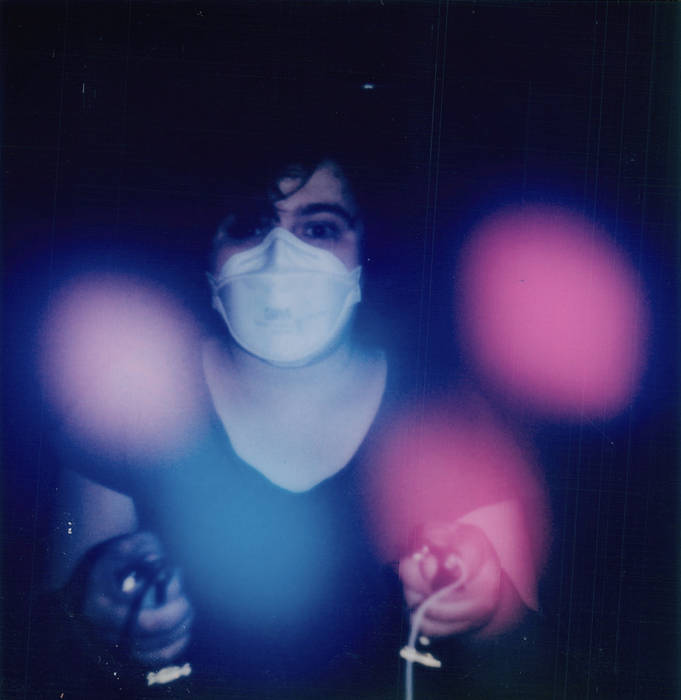
I link up with Hannah Jocelyn, the brains behind the independent queer synthpop project The Answers in Between, at Cafe Flor in Chelsea a few nights before Halloween. Ear-splitting techno music that sounds like it would’ve been played inside the rave hangar at Woodstock ’99 is blaring through the speakers in every corner of the room. We look at each other, I motion to the outside seating area, and Hannah emphatically nods before we settle down at a small table under the chilly October breeze. The chugging rhythm of the ACE subway cars rumble underneath us and we immediately get to chatting about her latest project Close Calls: Songs In Between.
Our conversation hits every corner of the zeitgeist that any chat between two avid music nerds would, and then some. Internet brain rot. Discord group chats spurned by frequent Stereogum commenters. The politics of Pitchfork scoring. The curious case of Coldplay. Even our top movie lists on Letterboxd (off the record). We also go deep into how Hannah’s transition during the pandemic and the intense relationships between queer women – both romantic and platonic – colored the songwriting on Close Calls, as well as the invaluable input they received from working with all queer femme collaborators.
How and when did you first get into making music?
So I found out pretty early on – maybe fourth or fifth grade – that I had perfect pitch, so I knew how to hear something and learn to play it by ear pretty early on. That’s when I started writing songs. I was a massive Coldplay fan at the time and – I mean, you’ve heard the EP, everything I do basically still sounds like Coldplay. But around high school I learned about mixing and mastering. I did an NYU songwriters program in 2015, and getting accepted into that made me realize that people actually thought I was good at this. There were a lot of people in that same program who’ve since gone on to be super successful. One of them is now an Emmy-nominated composer. In college, I started writing my own music, and I put out a project before the pandemic, around the same time when I started accepting that I was trans. There’s a line in one of my songs about praying that the world would stop, which was basically me saying, “Oh, I wish I could stop the world so I could transition.” And then the world did stop, so I did.
Tell me a little about your new project Close Calls: Songs In Between. How did the project come about?
Well, I had the idea that I would work on this album. So I started the process and had all these extra songs lying around. I thought those could just be b-sides or something. “Cigarette” was already out, just to have something there. So for Close Calls, I thought maybe I could throw together a few songs that I was confident about and call it an EP, and then I wrote “Where Do You Go?” which brought it to 7 songs, reaching the stage of being not quite an album, not quite an EP. So I ultimately just decided to call it a “collection of songs.” It’s quite similar to the previous project I put out, Self Talk. Both are about very intense friendships with queer women and how that kind of feels like walking through fire, not understanding why I was being treated a certain way, why relationships were and weren’t happening. That’s where the song “I’m New Here” came from, just me having no idea what’s happening. I emerged from the pandemic having just transitioned and sort of got thrown into the deep end with really intense people and intense relationships. I feel like Close Calls is slightly more mature than Self Talk, with tighter pop songs that aren’t quite as sprawling as the older ones. I named it Close Calls to be frank about all of the almost-friendships, and almost-relationships and situationships I was having at the time.
What do you think was the biggest common thread running through those relationships?
Wow, what a good question. I mean the song “Cigarette” is a great example of this. It’s all about looking for an identity in another person, and just wanting to be them instead of figuring out who you are as your own person. And I think most of these songs are about wanting a type of intimacy that’s just out of reach and there’s something in the way of closeness. “On Repeat” is about being physically too close with someone. I feel like there is a loose arc of crushing on somebody, falling out of that phase, and then these buffers of “Okay, who am I actually?” like “I’m New Here” and “Where Do You Go?” which I think do a nice job of breaking up the crush songs, so the project doesn’t get so myopic.
That makes sense. Wanting intimacy, but also fearing it because once you have it, then you have something to lose.
For sure. I definitely have anxious-preoccupied thoughts about that. The song “Cigarette” is literally about seeing somebody cute at the club and wanting to take them home, which is every club pop song ever.
In the clerb, we all in limerence with the hottie in the smoking section.
Exactly, you get it!
Your songwriting is obviously very stream-of-conscious and confessional. Who influenced you to write this way?
Scott Hutchison from Frightened Rabbit. No hesitation. I would say Pedestrian Verse is my favorite album ever. He has a very signature tone of reluctant nervousness that I always try to hit, the idea of having big emotions without being cloying or overly sentimental.
You mixed and mastered most of the project yourself with all queer collaborators. Would you tell me a little about each of them and how they got involved?
So Claire Bohlsen who worked with me on “Limbal Ring” was someone I met online through religiously commenting on Stereogum articles as teenagers. That song went through so many variations, it was initially just me ripping off “Making Plans for Nigel” by XTC. Then it started to sound like a CHVRCHES song, so that’s when I asked for her input. Claire ended up contributing some very Phil Collins-esque drums that I didn’t end up using a ton of, but I used enough where it kind of filled out the space a little more, and ended up sounding more like its own thing.
Hallie Melton did mastering, and they cut their teeth working for Nathan Dantzler who does mastering for a lot of really big pop stars. He did most of the Niall Horan stuff and “Espresso” by Sabrina Carpenter. You can hear Hallie’s touch all over “Cigarette,” where I wanted really big bass and to make the drums more aggressive than usual. And they just knocked it out of the park.
Heather Kirby is another one. There’s one song in particular called “How Strange,” which I initially released under another title, and then I decided to rework it. The song is about being at the mercy of someone else’s comphet, so it’s basically “Good Luck Babe”, but that hadn’t come out yet when I originally wrote it. So when I finally recorded it, I asked Heather to use “Good Luck Babe” as a reference, and I was so relieved when I finally got the master back and it sounded exactly as I envisioned it. She also made “On Repeat,” and “I’m New Here” sound great.
As somebody who writes about music for a living, how does that color the way you hear yourself?
Oh god, so much. Whenever I finish a mix, I am basically listening to it with my critic hat on and always wondering what I would change if I were reviewing the song. So I’m always asking the questions: What is this missing? Does this connect? Does it sound muddled? And so the next round of drafts and mixes are always informed by that mindset. Like, I don’t know if I would ever give myself an 8.6 Best New Music score on Pitchfork, but I also consider this project a stepping stone to the next thing I’ll end up making. But I honestly probably would be snarkier about my own music than I would be about someone else’s. I always try to be realistic about where I stand on my musical abilities at the current moment.
You’re a Coldplay head. What are your thoughts on their latest project?
I mean, I reviewed it! Basically, the way Pitchfork scores work is that the writer gives a score range and the editor has final say on the score. It was definitely the most 6 out of 10 album ever made, because there’s some incredible songs and then there’s some duds. For some context, Viva La Vida is one of my favorite albums of all time…
Shoutout Brian Eno.
Yes! They’re just so good at doing the classic Coldplay move, which is four people making big-sounding pop rock music. So it was definitely shameless fan service, which is part of why I loved some of it. I kind of sound like I’m having a stroke whenever I tell people how I feel about it, because it’s so all over the place. So when they take these big swings, they really excel at it, and then they attempt to do pop music and they’re just terrible at it.
Now that the project is out, what’s next for The Answers In Between?
I actually have my next couple releases knocked out and ready to go, some of which are older than Self Talk, including my album that I’m putting out. My next body of work is going to be a lot darker and is going the more brooding Fiona Apple/Tori Amos route. Maria BC was another big influence there. I definitely don’t wanna be in my 40s and still writing about unrequited love. It’s complicated, but I’ll cross that bridge when I get there. Thanks for having me!
KEEP UP TO DATE WITH THE ANSWERS IN BETWEEN
LISTEN