
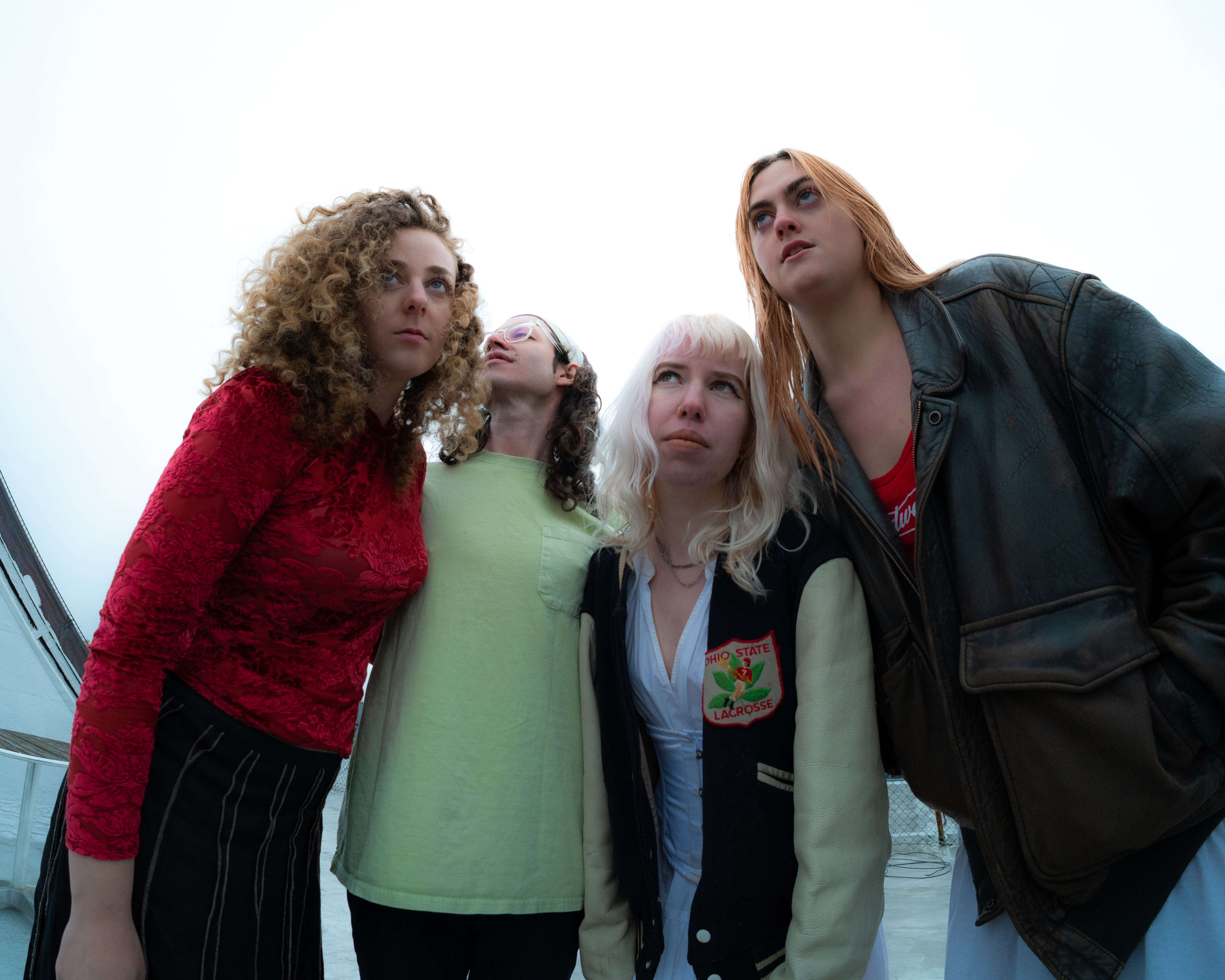
For Brooklyn-based queer femme punk quartet SHAGGO, their debut album Chores has been nearly a decade in the making – a few of the songs seeing their their first iterations when frontwoman Lucy Rinzler-Day was just 19 years old. Flanked by Carina Greenberg on bass, Christine Barcia on drums, and Thea Divine on lead guitar, SHAGGO came to form through a raw DIY ethos, a riot grrrl family lineage, and a shared admiration of 60s cult band The Shaggs.
Chores is a collection of lo-fi tracks that lurches between a propulsive punk rock kick, angular rhythms, and the catchy self-deprecating whimsy and charm of the early aughts anti-folk fringe. The beginning of “My House” calls to mind The Moldy Peaches before evolving into blown out distortion and sophisticated melodies reminiscent of The Yeah Yeah Yeahs Fever to Tell era.
Rinzler-Day’s family tree also plays a major part in this project, with two songs “Big Trash Night” and “Young Girls Need Entertainment” being based on original poems and songs that her parents wrote when they were close to her age.
A Grrrl’s Two Sound Cents sat down with SHAGGO to discuss the records they were raised on, friendship breakups, airdropping memes to strangers, and the transformational periods of personal growth they document on Chores.
I quite literally squealed when I read that your name is inspired by The Shaggs. What is it about them that you’re so drawn to, and how would you say your output is inspired by them?
Carina Greenberg: I think it’s pretty wild. Going back to our first two demos we recorded with a good friend — we did them live, probably close to two years ago now. We recorded “Minor League” live in Lucy’s living room. It was extremely lo-fi. That was around the time we picked our name.
Listening to those versions of the songs, you really hear how it could, in some ways, be like the Shaggs. Not totally, but there’s something raw and charming about them that we couldn’t recreate now if we tried. We were a three-piece, really stripped back, and just getting confident with our instruments. We’ve grown a lot since then.
The original story of how we got our name — Lucy had been in a couple bands as a singer/guitarist, and Riley, our first drummer, and I were new to our instruments. We were openly learning. We said, “We’re just gonna go for it — it’s punk, it’s about the feeling.” We had a few notably male friends say, “You’re just like the Shaggs — three women who don’t know how to play their instruments.” It might’ve been meant as an insult, but we thought it was kind of awesome. We love that the Shaggs have a cult following now. We weren’t three sisters forced into music by a crazy dad, but there were parallels.
Their album has so much charm and spirit. We’ll probably release those original demos on Bandcamp — they belong on cassettes. With Chores, it’s less clear that we sound like the Shaggs, but the influence is still there.
A Dutch magazine reviewed our singles and leaned into the Shaggs comparison on “Minor League” really hard. He dissed us a little but still wrote an interesting piece. It’s funny how people stretch to make those comparisons.
Lucy Rinzler-Day: We’re kind of absurdist — some of our lyrics are especially absurd, especially a song like “Minor League.” The Shaggs feel like an absurdist project, like outsider art or something from an Eric Andre skit. I showed one of my friends, who’s a Norwegian immigrant, the song “My Pal Foot Foot” as a funny “welcome to America” bit. The lyrics are bizarre, and that randomness resonates with us. Some of our songs are just truly random.
Chores feels transformational — moving through growth, coming of age, everyday tasks. What were some key reflective moments in your lives that made their way onto the album?
Rinzler-Day: Freshman year of college, I wrote “My House” about being super lonely. I changed a lot between high school and college. It took time to find my people — it was hard. That summer, I had a babysitting gig in rural France, brought my acoustic guitar, and started writing songs after the kid went to bed. I wrote about that year.
Other songs came from that era too, though we’ve weaved out some that don’t fit our vibe anymore. I’ve talked to my roommate and brother — those transitional years are lonely. In high school, I was acting one way. In college, I became something else.
Another big songwriting moment came after a really shitty year. I was in a superficial relationship that didn’t inspire any songs — but the aftermath did. I was craving romance and passion, and got tangled in confusing love situations. A lot of performative feminism, woke-fishing, clout-chasing. Four different “he/they” situations inspired the song “I Wanted Fun.”
A third key moment was collaborative studio writing — me, Lucy, and Riley having fun, stream-of-consciousness sessions. That’s how “Lost a Sock” and “Minor League” came to be.
Greenberg: Building off “My House” — Lucy wrote it at 19.
Rinzler-Day: You can definitely hear that in the line “All my friends are hanging out without me.” It’s something we wouldn’t write today, but it’s so authentic. Teenage girls make amazing art. We workshopped the song together, made it stronger without losing what it was.
It’s clearly a college friend breakup song — still teenager-adjacent. Etching out of that time. Those moments definitely made their way onto there.
How and when did music become such an integral part of your lives? Can you recall specific moments?
Greenberg:I felt like I was developing an identity when I started discovering music on my own — not influenced by anyone else. Tumblr was huge. I got really heavily into Vampire Weekend and Lorde’s Pure Heroine changed me. I was in choir, so backing vocals came naturally.
During the pandemic, I started learning bass. But bass is meant to be played with others. In 2021, I met Lucy and Riley — Riley was learning drums. We decided to just go for it. That gave me a reason to improve, and I started thinking about music from the other side — not just as a fan.
Rinzler-Day: I was also a Tumblr girly. Vampire Weekend, Arctic Monkeys, MGMT — my dad is a huge influence. He got me into music, took me to shows, pushed me, but in a good way.
Sophomore year, I got into Tame Impala. Junior year, I was like “too many men,” so I started seeking female songwriters. I heard Angel Olsen’s “Forgiven/Forgotten” at a Shake Shack and it changed everything. Through her, I found Mitski, Frankie Cosmos, Waxahatchee, PS Eliot… They felt like friends in high school. I actually became Twitter mutuals with some of them. I met Mitski at a small show and she told me to follow my dreams. When I was little my uncle got me a karaoke machine and I’d sing Shania Twain and Hilary Duff. I’ve always loved silly pop melodies.

Lucy’s mom read us her Riot Grrrl poem over dinner, and we loved it. Some words were outdated, but the themes were timeless. We picked the throughline: how even teenage girls are expected to mother and take care of men. We wrote the melody ourselves. The poem didn’t have one. But the spirit remained. It’s about forced mothering roles and saying no to that.
– Carina Greenberg (SHAGGO)
Lucy, I understand the album features writing from both of your parents when they were teenagers — one repurposed from a punk song your dad wrote, and the other from a Riot Grrrl poem your mom wrote. How did you update these to fit the personality of SHAGGO without sacrificing their spirit?
Rinzler-Day: Carina, you helped me write a lot of the lyrics, so you can speak to this too.
Greenberg: “Big Trash Night” and “Young Girls Need Entertainment” had different processes. “Big Trash” was originally a song we didn’t think we’d play live, but it was so catchy and fun. We added a more complicated rhythm, sped it up a bit. We only changed one lyric section — a modern bridge. Lucy mostly wrote that. It added weight — more about tossing out what’s weighing you down. Annoying people. Bad friends.
We added modern details — “Japan obsession,” which was a loving jab at Lucy’s brother who owns too many anime posters. “Young Girls” was different — Lucy’s mom read us her Riot Grrrl poem over dinner, and we loved it. Some words were outdated, but the themes were timeless.
We picked the throughline: how even teenage girls are expected to mother and take care of men. We wrote the melody ourselves. The poem didn’t have one. But the spirit remained. It’s about forced mothering roles and saying no to that.
It’s cool to honor our parents—they were our age when they wrote this stuff, and it resonates today.
Rinzler-Day: Yeah, it’s meta — a song about mothering based on a poem by my mom. For “Big Trash,” we made it more fun and feminine. The original lyrics mentioned a tool shed and “walking away from a heavy burden.” Ours says, “walk away like a cleansed bitch”—something my best friend told me after a breakup. We added lines about grocery apps and Marie Kondo. It’s about modern clutter. My mom says our songs are about modern life in New York, so modern clutter fits well.
This record clearly carries a range of influences — from ‘90s alternative rock to Riot Grrrl. But many songs began when Lucy was 19. What were you listening to then, and how has that evolved?
Rinzler-Day: Definitely Mitski’s Bury Me at Makeout Creek and Puberty 2. Over time, I’ve become less ashamed of what I like. I used to care about Pitchfork scores. Now, I’m like — I love pop music. I love “bad” music. I recently said Nickelback is good, and I stand by it. Also Hilary Duff’s songwriting should be studied.
Yes! We were both really into Palehound, Lala Lala, Frankie Cosmos. We connected over that right away — Carina and I’s Spotify blend was 96%. Finding that scene in college helped.
Greenberg: We’ve realized that things we loved as teens still slap. Katy Perry’s acoustic album? Incredible. It’s bled into our movie taste too. Chick flicks once considered “low-brow” are actually awesome. Like Ella Enchanted — perfect film. Anne Hathaway singing Queen and Elton John? Flawless.
Freaky Friday too — band vibes, the mother/daughter dynamic. It’s very us. 10 Things I Hate About You — that soundtrack? So good.
When you first started collaborating, what made you realize that you two were really linked — as friends and as creative partners?
Rinzler-Day: Honestly, I think I knew we’d be close after our hike up Mount Beacon. It was such a random day, but also kind of a turning point. My extremely boring placeholder boyfriend was with us — he barely said a word — but at the end, he was like, “That girl is so funny. You guys were bouncing off each other, telling these wild family stories and dreaming up film ideas and band concepts.” He was like this unimportant but omniscient narrator who just confirmed it for me: we had something.
Greenberg: That day really was something. On the train back, we were totally exhausted but started randomly airdropping memes to strangers. One guy accepted and sent some back — turns out he was a comedian from New York, and we still follow each other.
And from there, it just kept clicking — shared interests, overlapping tastes. Like yeah, our lead guitarist Thea brings this sick ’90s taste, but we both love Talking Heads, Angel Olsen, folky stuff, Lala Lala. So when we decided to start a band, it just made sense to blend those worlds — punk, melody, weirdness.
It sounds like you’re not just creative together — you actually follow through on stuff, which is rare.
Greenberg: Yeah. That’s been the difference. So many friendships where you talk about doing stuff and then… nothing happens. But we really do the things we say we’re going to do.
Rinzler-Day: Totally. Carina is one of the most motivated and organized people I know. I’m more chaotic, but I bring the enthusiasm. We balance each other out. It works.

Half our band is trans femme, and it feels especially urgent right now to create space, raise awareness, and support each other. This is not theoretical for us — it’s personal.
– Carina Greenberg (SHAGGO)
So what’s next? What are you scheming up?
Rinzler-Day: Fundraiser shows, another album. We would love to throw some type of “Rage Fest.” That’s our big dream right now. Just this idea of channeling political anger — especially with everything going on — into action and fundraising.
I was with my family all weekend and every time Trump came up, I was like: Rage Fest. Let’s just raise a ton of money and put on the most cathartic, loud, queer, beautiful show we can.
Greenberg: Half our band is trans femme, and it feels especially urgent right now to create space, raise awareness, and support each other. This is not theoretical for us — it’s personal.
Being in a queer femme band, we feel that responsibility. It’s scary out there, but that’s why we do stuff like this. We can’t fix everything, but we can do something.
On a lighter note — any mentors or creatives you look up to? People who helped shape your paths?
Rinzler-Day: I’d say my uncle. He’s kind of a chaotic mentor — he’ll blast Shania Twain and gift me vinyl even though I don’t have a record player. But the love is there. And he’s the first person I send lyrics to, along with Carina.
I think more than specific people, I’ve always felt inspired by our community. I grab lunch with other creatives in the city, I do brunches and wine nights. It’s all part of the creative dialogue. I’m not really into idolizing anyone — I just want to learn with and from my peers.
Greenberg: Same. But within our band, I look up to Thea and Christine so much. Thea has this amazing musical knowledge. She even corrected the way I play bass because I was hurting my wrist doing only upward strokes. And Christine, our drummer, is in a couple of other bands and just knows so much. I’ve learned a lot from both of them. It’s like big sister vibes.
It’s cool to be in a band where mentorship is kind of built-in. Everyone’s bringing something to the table — musically and emotionally.
KEEP UP TO DATE WITH SHAGGO
LISTEN